SEO title—
—
0 characters0 words
Start typing to search 227 tools.
Check SEO title and meta description lengths with practical search snippet guidance.
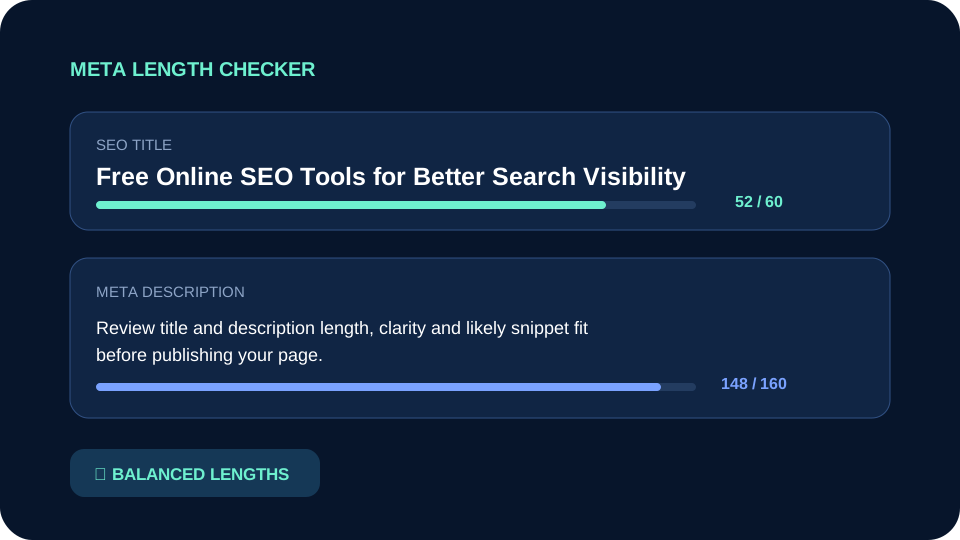
Meta Length Checker measures an SEO title and meta description before you publish them. It reports character and word counts, flags copy that is unusually short or long, and gives practical guidance without pretending that search results follow one fixed character limit.
Search engines can rewrite both title links and snippets, and rendered width depends on the characters used. The tool is therefore best used as an editing check alongside relevance, clarity, and search intent.
Focused controls, predictable output, and a workflow designed around this exact transformation.
Purpose-built fields keep the task clearer than editing raw markup by hand.
Common malformed values are rejected before the result is generated.
Results are formatted for quick review and implementation.
The same valid inputs produce predictable structured output without a third-party API.
Practical details about input, output, privacy, limits, and the best way to use this tool.
No. Search results are constrained by rendered space, not one universal character count, and Google can rewrite title links.
A practical editing range is often around 120 to 160 characters, but the actual snippet can be shorter, longer, or rewritten.
Length by itself is not a direct quality score. The main risks are truncation, diluted intent, or less useful wording.
No. Use enough space to describe the page accurately and give searchers a reason to click without padding the text.
No. It provides deterministic text counts and editing guidance, not a promise of how a search engine will render a result.
Check SEO title and meta description character counts and get practical editing guidance before publishing. A dedicated interface reduces syntax mistakes and makes the generated result easier to audit before it reaches a template, CMS, or production page.
The output should always represent the real page or entity. Technical validity is useful, but accuracy, consistency, and visible user-facing content remain more important than simply adding more metadata.
Start with the final page or entity information rather than placeholders. Enter stable canonical URLs, use the same names and descriptions visitors see, then generate the output. Read the generated result once before copying it and confirm every optional property has a real source.
When the underlying page changes, regenerate or update the markup at the same time. This is especially important for commercial values, identity details, navigation paths, and frequently edited copy.
Check syntax, absolute URLs, spelling, entity names, and whether every generated property can be verified from the page or official source. Avoid adding unsupported claims merely because a field exists. Search engines and other consumers may ignore, rewrite, or stop supporting particular presentation features over time.
After implementation, inspect the rendered HTML rather than only the CMS editor. Make sure there is one intentional version of the data and that plugins or themes are not injecting conflicting duplicates.
A useful Meta Length Checker should do more than display a raw character total. First, confirm that the title describes the page accurately. Second, place the main search topic early enough that a reader can understand the result quickly. Third, remove repeated words that waste visible space. Fourth, make the description specific to the page instead of reusing generic copy. Fifth, include a concrete benefit, feature, or outcome when it is genuinely supported by the page. Sixth, read both fields as natural sentences rather than treating them as containers for keywords. Seventh, compare the final wording with the visible page heading and content so the search snippet does not promise something the page fails to deliver.
Character ranges are editing guides rather than ranking rules. A short title can work when it is precise, while a longer title may still be useful if its most important words remain clear. The same principle applies to descriptions. Search engines can select different text for a snippet when another passage better answers a query, so clarity and relevance are more durable goals than filling every available character.
Before publishing the generated result, compare it with the final page rather than the draft you started with. Check every important value, remove placeholders, confirm that URLs resolve to the intended canonical resources, and make sure visible page content supports the structured or SEO data you generated. This final review catches mistakes that syntax validation alone cannot detect.
After deployment, inspect the rendered source instead of assuming the editor output is identical to the public page. WordPress themes, caching layers, SEO plugins, minifiers, and other extensions can alter or duplicate metadata. A quick source check confirms that the intended output is present once, uses current values, and is available to crawlers without depending on an interaction.
Build broader structured data with Schema Markup Generator, preview search messaging with SERP Snippet Preview, and prepare standard page metadata with Meta Tags Generator.
For structured-data vocabulary, review Schema.org. For search implementation guidance, review the current Google Search structured data documentation.