01
Many totals at once
Words, characters, sentences, paragraphs, lines and bytes in a single run.
Start typing to search 227 tools.
Count words, characters, sentences, paragraphs and lines in any text, with an estimated reading time. Works with Unicode text.
The word counter measures a piece of text and reports the number of words, characters (with and without spaces), bytes, lines, sentences and paragraphs, together with an estimated reading time. Paste an essay, an article, a product description or a social post and see at once whether it fits the limit you have to meet.
Counting follows simple, stated rules, described below, so you know exactly what a “word” or a “sentence” means here. For a closer look at characters only, use the Character Counter.
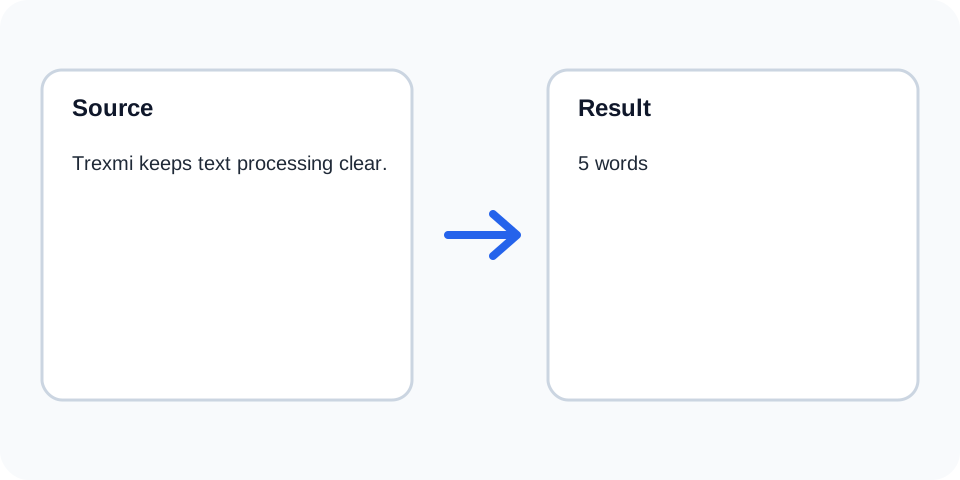
Focused controls, predictable output, and a workflow designed around this exact transformation.
Words, characters, sentences, paragraphs, lines and bytes in a single run.
Words, sentences and paragraphs follow rules you can read on this page.
Letters from any alphabet count as words, and an emoji counts as one character.
An estimate at 200 words per minute helps you plan how long a text takes to read.
Practical details about input, output, privacy, limits, and the best way to use this tool.
A word is a run of letters or digits, optionally joined by an inner apostrophe or hyphen. So “well-known” and “don’t” are one word each, and “2024” counts as a word. Punctuation on its own, such as a dash with spaces around it, is not counted.
The text is split at full stops, question marks and exclamation marks. A piece counts as a sentence only if it contains at least one letter or digit. Abbreviations such as “e.g.” or “Dr.” can therefore be counted as sentence ends, so treat the sentence total as an estimate.
A paragraph is a block of text separated from the next by at least one empty line. A line break without an empty line does not start a new paragraph.
Characters are the symbols a reader sees; an emoji or a letter with an accent counts as one. Bytes are the storage size in UTF-8, where non-Latin letters and emoji take two to four bytes each. Some systems limit bytes rather than characters.
Words are divided by 200 words per minute and rounded up, with a minimum of one minute for any non-empty text. Real reading speed varies with the reader and the subject.
Yes. Letters from any script are treated as word characters. Languages written without spaces between words, such as Chinese or Japanese, are not segmented into words by this tool.
There is no fixed limit in the tool, but very large texts depend on your browser and may be slow to process.
Essays, articles and assignments usually have a word target. Titles, meta descriptions, ad copy, product names and social posts are normally limited by characters. Database fields and some APIs limit bytes, which matters for text in non-Latin scripts and for emoji. This tool shows all three, so one run covers every case.
A count is a planning aid, not a quality measure. Use it to hit a required length, to compare drafts, or to see whether paragraphs are balanced. If a text feels repetitive, compare its total word count with the number of distinct words from the Unique Word Finder, or check how often a key phrase appears with the Keyword Density Checker.
Different programs count differently. Word processors, publishing platforms and plagiarism checkers may treat hyphenated words, numbers, URLs or abbreviations in their own way, so a total can differ by a few words. If an official limit applies, confirm the result in the system that will enforce it, and leave a small margin.
Count characters in detail with the Character Counter, estimate how long a text takes to read with the Reading Time Calculator, list distinct words with the Unique Word Finder, or analyse keywords with the Keyword Density Checker.