01
Clear browser workflow
A focused operation produces a result that is easy to inspect and compare.
Start typing to search 227 tools.
Count total, non-empty, and blank lines in text, code, lists, logs, and documents with a clear browser workflow
Line Counter is a focused browser utility designed to count total, non-empty, and blank lines in text, code, lists, logs, and documents with a clear browser workflow
This line counter keeps the original input separate from the processed result, which makes review easier and reduces accidental copying mistakes. It is useful when you need a quick answer but still want enough context to verify what changed.
Paste representative content, run the operation, inspect the full result, and test it in the real destination before replacing production data. The visual guide below summarizes a safe input, process, review, and copy workflow.
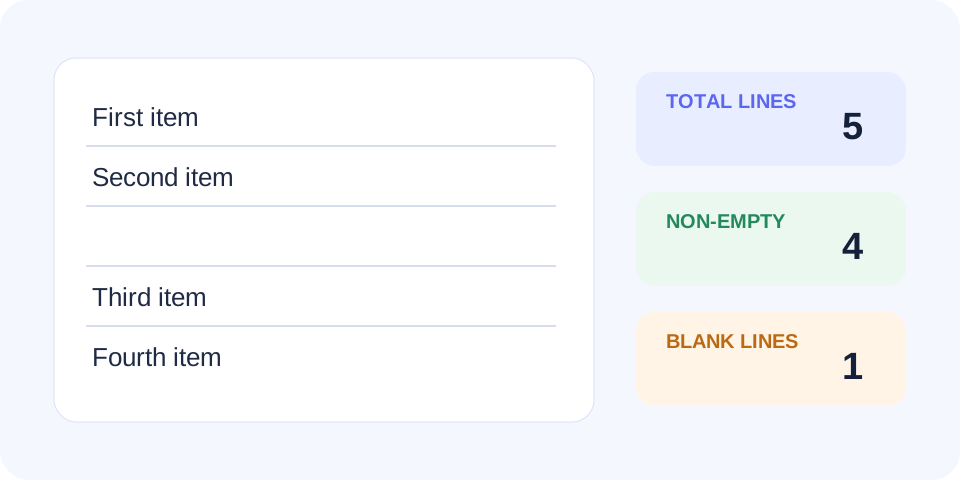
Focused controls, predictable output, and a workflow designed around this exact transformation.
A focused operation produces a result that is easy to inspect and compare.
The original input remains visible for correction and verification.
Processed content is displayed independently from the source.
Practical checks help reduce mistakes before publishing or importing.
Practical details about input, output, privacy, limits, and the best way to use this tool.
It count total, non-empty, and blank lines in text, code, lists, logs, and documents with a clear browser workflow
No. The source remains visible while the processed result is shown separately.
Common Unicode text is supported, but unusual or malformed characters should be tested with representative input.
Check for hidden spaces, line breaks, invalid syntax, partial input, or content that was already processed.
Yes, but test a smaller sample first and inspect the beginning, middle, and end of the final result.
No. The receiving application, parser, import format, or publishing platform remains authoritative.
Yes. Keep an untouched copy whenever the source is important or difficult to recreate.
Avoid pasting passwords, tokens, private keys, or sensitive production data into any environment you do not trust.
The line counter applies one clearly defined transformation or analysis to the text supplied in the input area. The source remains visible while the result is produced separately, so you can compare both versions before copying anything.
Browser tools are convenient, but the destination system remains authoritative. A value that looks correct on screen can still fail because of hidden characters, unsupported syntax, a different character encoding, strict import rules, or an incomplete copy.
Typical uses include editing, content migration, development, quality assurance, search optimization, documentation, data cleanup, form preparation, configuration review, and test-data creation. The line counter is especially helpful when a manual operation would be repetitive or easy to perform inconsistently.
Use a realistic sample instead of a simplified example whenever possible. Representative input exposes line breaks, punctuation, Unicode characters, spacing, separators, and edge cases that may otherwise remain hidden until publication or import.
Keep an untouched copy of important source content. Confirm that the complete value was pasted, including the first and last characters. Check for smart quotes, non-breaking spaces, tab characters, trailing whitespace, blank lines, and characters copied from rich-text editors.
For large inputs, test a smaller section first. A short trial makes it easier to understand the operation and confirm that the line counter matches the workflow you actually need.
Do not review only the first line. Inspect the beginning, middle, and end of the output. Compare totals, delimiters, nesting, spacing, or visible text according to the purpose of the tool. Copy the result only after it passes this comparison.
When the output will be imported into another platform, test one record or a staging copy before processing the full dataset. This simple step can prevent broad formatting errors and makes rollback much easier.
If the result is empty or different from what you expected, confirm that the input is valid for the selected operation. Check whether it was already processed, partially processed, truncated, or copied with invisible formatting. Running the same conversion twice can also create a different result.
Try a minimal example, then add complexity gradually. This helps isolate the exact character or structure that causes the problem. The line counter should support verification, not replace testing in the destination application.
Avoid pasting passwords, private keys, access tokens, customer records, or confidential production information into any environment you do not trust. Encoding, formatting, counting, or minifying data does not automatically make it private or secure.
Before finishing, confirm that the entire output was copied, the destination accepts the result, and the original source is still available. A careful final check is faster than repairing a broken import, template, page, or configuration later.
Line Counter works best when you start with representative text and keep the original source available. Use line counter on a small sample first, compare every change, and confirm the result before processing important content.
When using line counter, check whitespace, punctuation, Unicode characters, line endings, and any values whose meaning depends on formatting. This review step helps prevent accidental changes that are difficult to reverse later.
Continue with Word Counter or Character Counter for a related workflow.
For general web-platform background, consult the MDN Web Docs reference.