01
Rank every repeated word
See the most common terms first instead of searching through a long article manually.
Start typing to search 227 tools.
Count how often every word appears, rank repeated terms, and inspect vocabulary balance in any pasted text.
Word Frequency Counter gives you a focused workflow for this task. Use word frequency counter with representative input, review the complete result, and verify the output in the destination system before production use.
Word Frequency Counter analyzes pasted text and ranks words by the number of times they appear. It helps writers, editors, SEO specialists, students, and content managers identify repeated language, dominant topics, accidental duplication, and vocabulary patterns without changing the source.
The analyzer treats capitalization consistently, so Tool and tool are counted together. Punctuation surrounding a word is ignored for the frequency ranking, while the original text remains untouched. A frequency list is evidence, not an automatic quality judgment: brand names, technical terms, and core topic words may need to repeat.
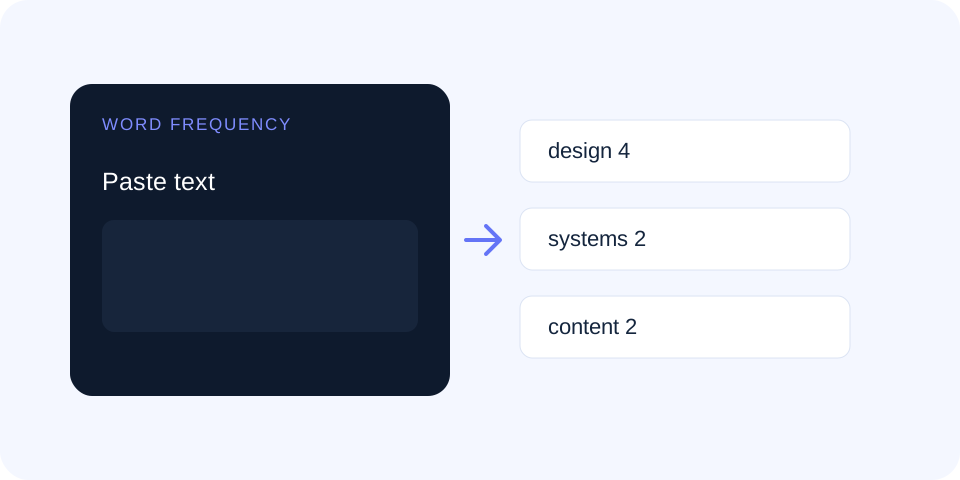
Focused controls, predictable output, and a workflow designed around this exact transformation.
See the most common terms first instead of searching through a long article manually.
Compare total words with unique normalized terms to understand how varied the language is.
Spot repeated filler words, duplicated product claims, and transitions that weaken readability.
The analyzer reports patterns without rewriting, deleting, or reordering your original text.
Practical details about input, output, privacy, limits, and the best way to use this tool.
Uppercase and lowercase versions are grouped together for the ranking. This prevents sentence capitalization from creating separate entries.
Punctuation around a word is removed for frequency analysis, so tool, and tool. are counted as the same term.
No. Topic terms, product names, names, and necessary technical vocabulary often repeat. Use the results to review context rather than deleting every common word.
It provides a transparent frequency table, but it does not determine search intent, rankings, or ideal density. Use it as one editorial signal alongside readability and relevance.
No. Common words remain visible because they can reveal writing style and repetition. You can ignore them manually when reviewing the ranking.
No. The source remains editable and unchanged. Only a separate ranked result is produced.
Word Frequency Counter works best when the source is realistic and the result is reviewed before export. Use word frequency counter on a small example first, then repeat the same word frequency counter workflow with a production-like sample that contains no private data.
After running word frequency counter, compare the source and result, check special characters and empty values, and test the output in the receiving application. A reliable word frequency counter workflow keeps the original input available until the destination accepts the result.
Typical mistakes include incomplete input, incorrect assumptions about defaults, hidden whitespace, encoding differences, and skipping final validation. When word frequency counter gives an unexpected result, reduce the example to the smallest failing case and add complexity back one change at a time.
Continue with Word Counter or Unique Word Finder for a second formatting, validation, or verification step.
A ranked frequency table makes language patterns visible. In long product descriptions, articles, reports, and support documentation, readers often notice repetition before the writer does. Counting provides a neutral starting point: total words show sample size, unique words show vocabulary breadth, and the top frequency highlights the strongest repeated term.
Frequency is most useful when compared with purpose. Repeating a precise technical term may improve clarity, while repeating vague words such as “great,” “very,” or “solution” can make copy feel generic. Inspect the sentence around every high-frequency term before changing it.
Do not replace words mechanically. First decide whether the repetition identifies the subject, maintains terminology, or simply fills space. Keep consistent names for features, products, and procedures. Rewrite accidental duplication, especially when the same adjective or transition appears in nearby sentences.
For broader structure measurements, compare the source with Text Statistics. When the goal is a unique list rather than a report, use Remove Duplicate Words.
A this counter can show whether a focus phrase appears naturally, but no universal percentage guarantees rankings. Search engines evaluate meaning, usefulness, intent, structure, and many other signals. Avoid inserting a keyword only to reach a number. Write complete answers first, then use frequency data to detect obvious overuse or missing terminology.
For an introduction to how search systems understand content, see the Google guidance on helpful content.
The this counter helps reveal repeated language without changing the source. Use the this counter after editing to confirm that vocabulary balance has improved.
Automated counting does not understand sarcasm, brand requirements, synonyms, grammar, or whether repetition is persuasive. Hyphenated terms, contractions, URLs, and language-specific forms may also need human review. Treat the ranking as an editorial map, not a final verdict.